
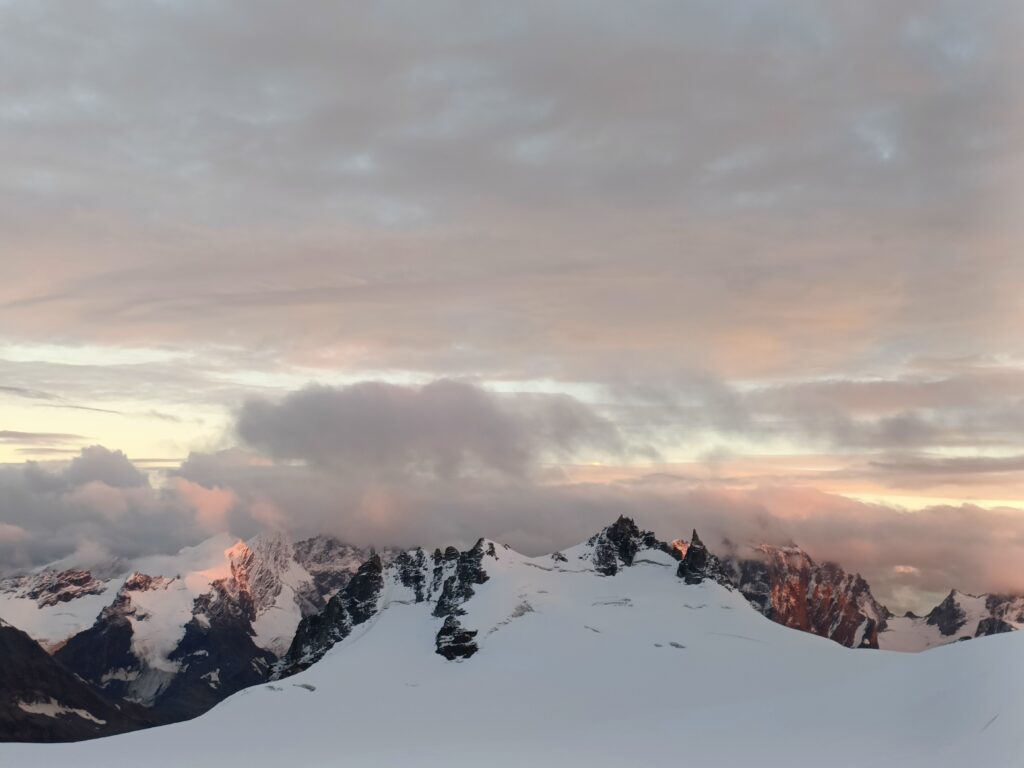
A mountain that is situated in the Pir Panjal range is famous as Deo Tibba. The mountain is located southwest of Manali and above the village(Jagatsukh). The height of Deo Tibba is 6001 meters and is in Kullu District. The meaning of Deo is (Gods) and Tibba means (Hills). It is said that Devtas used to assemble there at the dome-shaped peak and have great religious beliefs.
The climb to the summit of Deo Tibba is challenging, but the reward is an exhilarating view of vast snowfields, hanging glaciers, and lofty peaks of the surrounding ranges. Climbers must tackle difficult terrain, including steep ice passes, crevassed glaciers, a rock fall area, and a ridge. The mountain has an extensive ice cap, and climbers must ascend a challenging hump of inclined wind slab snow using crampons, ice axes, and fixed ropes.
Due to the technical nature of the climb, Deo Tibba is not recommended for absolute beginners. However, those with previous trekking and climbing experience and knowledge of snow, ice, and mountaineering techniques can attempt this expedition.
Itinerary
DAY 01: Day 1: Jeep ride to Jagatsukh dam and trek to Chikka.
The day will start early with a jeep ride from Manali to Jagatsukh dam(2,700 meters). We will then start the trek for Chikka Campsite(3,000 meters) which will take us around 2 hours from Jagatsukh Dam. Overnight stay at Chikka campsite. The campsite is just next to the local temple and next to Jagatsukh Nala.
Day 02: Chikka to Seri
Altitude Gain: 750 Meter/ 2400 Feet
Trek Distance: 7-8 Kilometers
Trek Duration: 5.5 to 6 hours
Trail Type: Walking forest with meadows and huge rocks
Difficulty Level: Moderate
Water Sources: Sufficient water
The area is so revitalizing, that you will wake up fresh for the next day’s trek to Seri. The trek is full of stones and will be through the Jagatsukh Nallah. We will trek along the tree line to reach Seri alpine meadows. The beginning of the trek will have heavy forests but later on, you will see the forest getting scattered and scanty. Be careful as the season is rainy, the stones get slippery so walk slowly on the big boulders that will be there after an hour of your trek.
Suddenly you will observe the splendor of hardy trees and a ground that is full of meadows. It is Seri, and the camp is just a few more kilometers from the alluring place. A bouldered section is visible after 3 km of the walk and the place is Panduropa where your camps are waiting for you. You may see a freshwater spring that will be pleasing and enjoyable at Panduropa. The camps are placed to give a better view of the cliffs of Norbu, Malana Pass, Jagatsukh, and some parts of Deo Tibba Peak. Enjoy the night at the campsite along with the bonfire.
Day 03: Seri To Base Camp (Tainta Camp)
Altitude Gain: 650 meters/2200 feet
Trek Distance: 8 Kilometers
Trek Duration: 5-7 Hours
Trail Type: The trek is mixed as there are walking grasslands and also steep climbs.
Difficulty Level: Challenging
Water Sources: Adequate Water
The trek will begin after you are done with your breakfast. Today’s journey will be a little harder than the earlier ones. As you walk along the Jagatsukh river, you will observe a monument and a waterfall, both are beautiful in their own way. On the way, you have to walk through a steep cliff for around 2 hours. The passage gets over as you reach the moraines. After a small walk of an hour, you will be there at the base camp that is Tainta Camp.
After the camp is established, we will move on to the Chota Chandratal. You ought to climb for approximately 2 hours to reach base camp 2. You will see a lake that is covered with wildflowers and also the peak towers of Deo Tibba. Further, we will return back to our base camp. The sky is vivid here and the camp is a closed valley and is not similar to the previous camps.
Day 04: Training Day
After reaching a height of 4200 meters, it becomes vital to take a day halt. It is quite dangerous for a person to cover distances so quickly as it leads to sickness. Let your body adapt to the environment and enjoy the lovely place. You can go to Chota Chandartal for a walk and can even just chill and relax at the camp. A briefing session will be organized in the evening to explain further plans.
Day 05: Load Ferry to Camp 1 Back to Base Camp
Altitude Gain: 600 meters/2000 feet
Trek Distance: 0.6 Kilometer
Trek Duration: 4 to 5 hours
Trail Type: Moderate to steep Climbing
Difficulty Level: Challenging
Water Sources: Have to carry an adequate amount of water.
Load Ferry means when you go to work at high altitudes but at the latter part of the day come back at low altitudes to sleep. You will carry all the vital types of equipment along with you to the higher camp and later will return to base camp 2. This is because high altitudes are different from the plains so it is important to return to lower levels. The lunch will be packed on the way and have enough water.
Base camp 2 is at the Dhanuan Pass and the location is visible from Base Camp 1 due to its orange color. Initial 200 meters of the trek you have to go through moderate climbing, further 300 meters there is steep climbing and the rest of the 100 meters have a flat slope. The slope is covered with snow, so you have to go slowly as it gets slippery. Be careful while walking as there are deep cracks. After completing your lunch, you have to walk down to base camp 1.
Day 06: Deo Tibba Base Camp to Camp 1
Altitude Gain: 600 meters/2000 feet
Trek Distance: 0.6 Kilometer
Trek Duration: 4 to 5 hours
Trail Type: Moderate to Steep Climbing
Difficulty Level: Challenging
Water Sources: Take enough water along with you.
Now, you are ready to move to base camp 2. You have to follow the same trek route that was completed a day before. Walk slowly and have enough rest and the journey is 4-5 hours. Be careful as there are rocks, snow, and deep cracks. Make sure that you are walking along with the guide and team to avoid any kind of uncertainty
Day 07: Camp 1 to Summit Camp
Altitude Gain: 500 meters/1600 feet
Trek Distance: 4 kilometers
Trek Duration: 4 to 5 hours
Trail Type: Area covered with snow
Difficulty Level: Moderate to Challenging
Water Sources: Carry hot water
The body must adapt to the environment so this will again be a load ferry. After the visit, we will come back to base camp 2 as there are chances of a lack of oxygen at higher altitudes. The area is full of snow so carry your waterproof clothes and gloves along with you.
Due to snow and climbing, there are chances of slippery surfaces so make sure you come along with your guide and team. The first hour of the trek has moderate climbing which will get steeper in the later hours. After spending some time at the summit camp, we will move back to base camp 2 so that nobody faces any health issues.
Day 08: Summit Day and Back Camp 1
Altitude Difference: 500 meters/1600 feet
Trek Distance: 4 Kilometers
Trek Duration: 4 to 5 hours
Trail Type: Snow Area
Difficulty Level: Moderate to Challenging
Water Sources: Carry hot water
The same routine that was followed a day prior will be done to reach the summit camp. Carry only the items that you need and leave the rest of the things in base camp 2 which will save you from carrying heavy luggage. The load ferry rule is vital in the case of trekking at higher altitudes as it saves a person from any sort of health issues. Walk slowly and along with the team as the area is covered with snow and there are chances of falling. You can have a good time in ice sports and skills. The night will be adventurous at the Summit Camp.
Day 09: Buffer Day
Altitude Gain: 400 meters/1300 feet
Trek Distance: 6 kilometers
Trek Duration: 4 to 6 hours
Trail Type: The summit is wide but becomes steep at the end
Difficulty Level: Challenging
Water Sources: Have adequate water with you
The trek to the summit attempt will begin early in the morning so have enough rest at night. The initial few kilometers are steep climbing so climb slowly and carefully on snow. A few hours later, you will see Indrasan Peak. The real problem is the lack of oxygen due to a surge in altitude. The trek is manageable but there are many deep cracks on the way. The last few kilometers are a flat walk to the summit. You can rest and spend some time at the summit but later on, return to base camp 2 due to oxygen problems.
Day 10: Camp 1 to Deo Tibba Base Camp
Altitude Loss: 600 meters/ 2000 feet
Trek Distance: 3 Kilometers
Trek Duration: 3 to 4 hours
Trail Type: Steep dropping
Difficulty Level: Moderate
Water Sources: Have enough water sources
So, now after the summit, the return journey begins. Be careful as now we are moving downwards, keep your knees a little tight so that you do not fall. The same path will be followed as we move upwards. Try to reach till lunchtime so that you can have ample rest for the next day but do not rush as there are many rocks on the way.
Day 11: Base Camp 1 to Chikka
Altitude Loss: 1400 meters/ 4600 feet
Trek Distance: 16 Kilometers
Trek Duration: 6 to 8 hours
Trail Type: Mixed steep and Flat descent
Difficulty Level: Moderate
Water Sources: Ample sources of water
This is your last tent stay so enjoy that to the fullest and try to reach early so that you can have fun. The path is mixed as it is steep somewhere and at times it is a downward walk. It takes less time in descent so you will cover a lesser time period. As it takes 6 to 8 hours so it is better to carry your lunch along with you.
Day 12: Chikka to Manali
Altitude Loss: 1050 meters/ 3450 feet
Trek Distance: 5 Kilometer
Trek Duration: 2.5 to 3 hours
Drive Distance- 12 Kilometers
Drive Duration- 1 hour
Trail Type: Easy
Difficulty Level: Moderate
Water Sources: Numerous water sources
Finally, trek and drive back to Manali after completing the challenging trek. Just trek to khanol and then drive to Manali. Walk carefully to avoid any injury. Collect all your equipment as it is time to say goodbye to the hills.
INCLUSIONS
All car transfers from Manali to Manali as mentioned in the itinerary.
All meals during the trek.
Excellent Expedition guide, who will be a local to this particular area and has profound knowledge of the trekking trails and peaks.
Specialized Cook, Support staff till base camp
Stay in tents on a twin or triple-sharing basis during the trek.
Camping equipment like Sleeping bag, Carry mattress.
Technical equipment like climbing boots, crampons, harnesses, rope, etc.
Kitchen tent and toilet tent till base camp
All permit fees, camping charges, and forest permission are required for the trek.
Basic Medical & First Aid kit.
Participants will get an exclusive discount on all Fast&Up products.
EXCLUSIONS
Travel till Manali
Personal clothing & Personal Porter
Any kind of personal expenses
Toiletries
Tips to guide/porter/staff
Anything not mentioned in the inclusions of the package.
Personal Insurance
THINGS TO PACK
For Your Head:
Woolen warm cap to protect against cold winds
Balaclava for extra warmth
Bandana (can be used as a sweatband or to cover your face from dust)
For Your Feet:
2-3 pairs of regular socks
1 pair of thick woolen socks for warmth
Trekking boots with ankle support and good grip
Extra pair of comfortable sneakers or shoes to wear at the campsite
For Your Hands:
1-2 pairs of warm inner gloves
1 pair of waterproof gloves to keep your hands dry
Hand warmers (optional, but useful in very cold weather)
A pair of fleece gloves for extra insulation
Clothing: The Armor of the Adventurer:
1 pair of thermal innerwear (top and bottom) for base warmth
2 pairs of lightweight, quick-dry trekking pants
1 pair of windproof and waterproof Gore-Tex trousers
1 Gore-Tex or waterproof jacket for wind and rain protection
1 poncho (optional) for sudden rain
1 fleece jacket for light warmth
3–4 full-sleeve dry-fit T-shirts for layering
1 heavy down or padded jacket for extreme cold
Navigational & Survival Gear:
20L backpack (for water, snacks, fleece, etc.)
Duffel bag (provided by us; carried by mules/porters)
1 trekking pole (or 2 for better balance)
Tiffin box for packed lunch
Filter water bottle
Thermos flask (for warm water or tea)
Personal Care Compact:
Toothbrush & toothpaste
Face towel, tissues & wet wipes
Hand sanitizer & lip balm
Moisturizer (optional but helpful in dry climate)
Personal medication kit
Sunscreen (SPF 50+)
Illumination & Eye Protection:
Headlamp with extra batteries – a must-have for night treks and early morning starts
Sunglasses – Polarized, Category 4 with 100% UV protection and a wrap-around fit to guard your eyes from harsh sun glare and snowy reflections. Carry a backup pair just in case.
PREPARATION GUIDE
Have Previous Trekking/Mountaineering Experience.
Weight training the body. Walk uphill or stairs steps with a weighted backpack.
Strength training for the lower body and core. Do planks, crunches and cycling.
Climbing Deo Tibba requires a fit body and a conscious mind. One needs to be exercising regularly for the past couple of months.
Any high-altitude trek requires you to build a good amount of cardiovascular endurance. Jogging is the best exercise to increase your stamina.
You need strong legs to successfully finish a high-altitude trek. Squats are the best way to build leg strength quickly. Especially your thighs, glutes and knees.
For detailed advice and coordination, we’ll have a WhatsApp group.